By Rachel Showstack
The COVID-19 pandemic may be behind us, but Wichita hasn’t stopped thinking about health. The Wichita Biomedical Campus is a $300 million project on South Broadway in downtown Wichita designed to focus on the physical causes of disease and the technologies created to address those causes (in other words, biomedical science and engineering). These are important components of making Kansas healthy, and they can become truly impactful when health is viewed wholistically and with all Kansans in mind. So, what is being done to make sure that Wichita’s wealth of health resources has a meaningful impact on Kansas communities?
In Wichita State’s Fairmount College of Liberal Arts and Sciences, students are going beyond the biomedical to advance our understanding of the human side of health and build a world in which the latest advances in health technology can benefit all humans equally. This means considering humanistic areas like cross-cultural communication, ethics, power dynamics, community health practices, personal experiences with health and illness, and the unique health needs of specific populations. All of these lines of inquiry come together in two Fairmount College programs: Alce su Voz (‘Speak Out’) and the Academic Center for Biomedical and Health Humanities (known as “HealthHum”). This intersecting pair of programs depends heavily on the expertise of students and faculty from across campus.
Health humanities is a transdisciplinary field that examines the relationship between the human condition and health through the lens of disciplines like history, anthropology, sociology, and cultural studies. Alce su Voz (ASV) is a prime example of a community-engaged public health program that draws heavily on frameworks and perspectives from the humanities. Our mission to advance health equity in multilingual communities requires a deep understanding of humanistic perspectives; we must consider how linguistic and cultural differences, and real or perceived relations of power, impact access to high-quality health care. To do so, we examine human experience by listening to individuals’ personal accounts of their interactions with the health care system. Sometimes, peoples’ stories illustrate how inadequate care delivery systems and policies have led to difficult emotional experiences and poor health outcomes. Therefore, we also need to consider how systems and policies can be improved to serve multilingual populations. This endeavor requires working closely with current and future health care professionals to improve patient experiences and outcomes, and it also requires expertise in a range of areas outside of the biomedical fields.
ASV has always relied on graduate and undergraduate students to contribute their unique expertise and draw on their lived experience to advance our mission. In the past, students working with us for course credit have been unpaid volunteers, but these students’ time with us is valuable and they deserve to be paid. The new Wichita HIREs program (short for Humanities Internships Reward Employers) has allowed us to bring three paid interns onto our team. The program provides paid, for-credit internships to undergraduate students majoring in humanities fields, such as history, philosophy, linguistics, or cultural anthropology, allowing them to utilize their skill sets to develop their careers and advance society. Funded by a grant from the Mellon Foundation, the HIREs program places student interns with non-profits, government agencies, and businesses while engaging in coursework that supports their internship experiences.
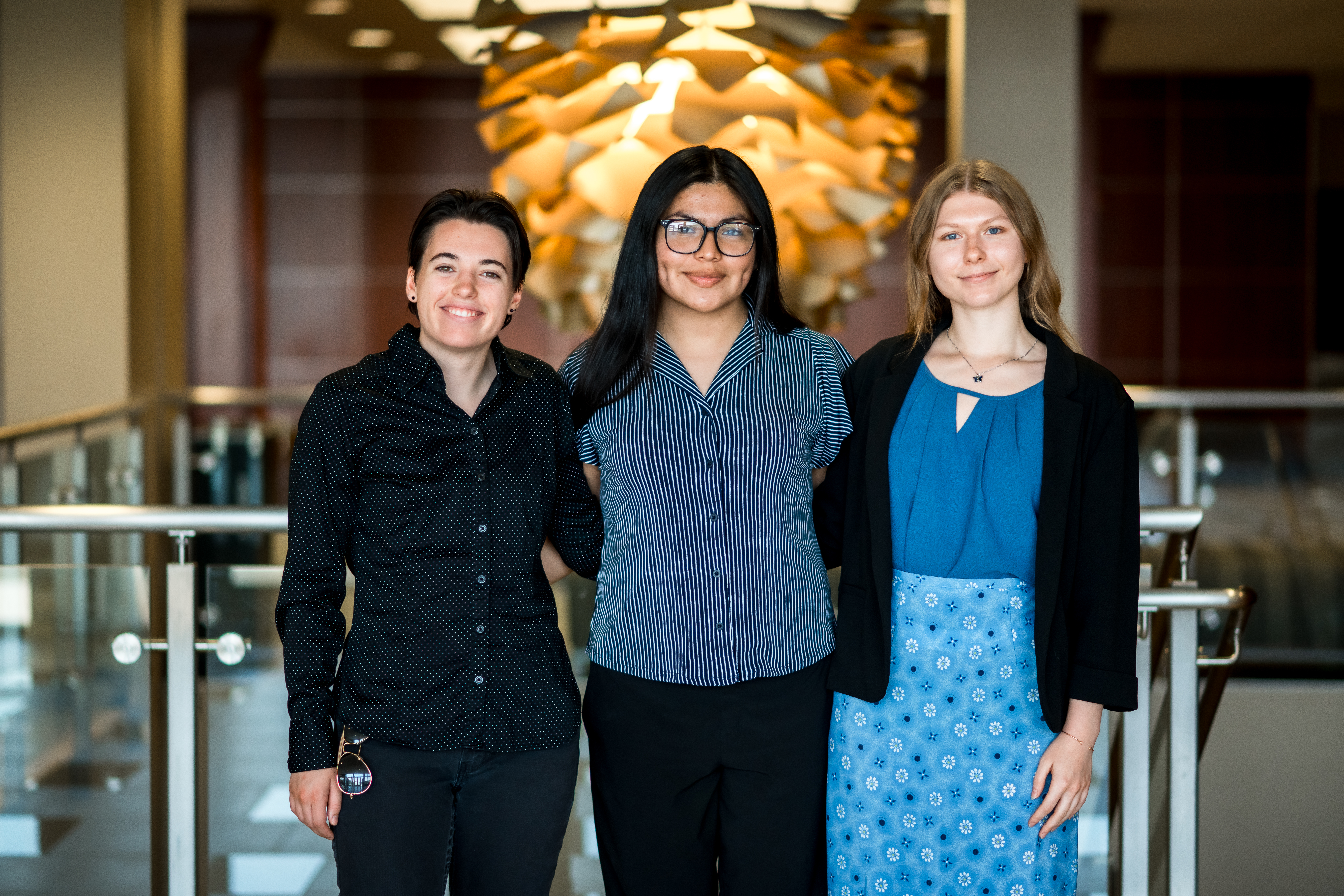
While most of the hiring agencies are off campus, ASV and HealthHum have been lucky to welcome some of the first HIREs interns. Wichita State undergraduate students Serenity (Ren) McDonald, Mariel Becicka, and Jamilid (Jam) Romero-Oritz are all Mellon interns with ASV this summer. Ren, who is majoring in Linguistics and Spanish, has been coordinating ASV tables at public events to talk with community members in Spanish and English about healthcare language access and the work we do to advance health equity for multilingual communities. With the help of Mariel, Jam, and undergraduate student Isabel Fulkerson, Ren is also leading the formation of a new Alce su Voz student organization. Mariel, who is majoring in Spanish and American Sign Language, is developing audio descriptions of our online content to make our work accessible to visually impaired individuals, and she will also be collaborating on ASV’s oral history project Stories of Language, Communication, and the COVID-19 Pandemic in Kansas Latinx Communities. Finally, Jam, a psychology major with a minor in Spanish, will be leading networking with students and producing social media content.
Alce su Voz is affiliated with HealthHum, which is a WSU center that connects students and faculty across campus who are engaged in health-related studies and community engagement, incorporating humanistic perspectives to complement and enhance the impact of the biomedical health professions. The center offers an Undergraduate Certificate in Health Humanities and regularly hosts guest speakers and faculty colloquia. Through the HIREs program HealthHum is now able to help health humanities students put theory into practice. In the inaugural semester HealthHum facilitated placements for Jayden Island in Student Health Services, Quinn Adams in HOPE Services, Sam Hoppe in Social Work, and even a Philosophy in Practice placement for Isla Running as a pre-law intern in the office of Tech Transfer and Commercialization. Students were able to work directly with patients and clinic staff on some projects, and to use their humanities skills in contexts that are under dehumanizing pressures.
In Fall 2026, the HIREs program will be expanding to include more partners outside of the university with a broader range of opportunities. Meanwhile, at WSU, Alce su Voz and HealthHum will continue to engage students from across campus to center humanity in health care.
Alce su voz is a community-engaged program at Wichita State University whose mission is to improve health equity for speakers of Spanish and Indigenous languages in the United States, with a focus on Kansas and the Midwest. For more information or to get involved, please send an email to alcesuvoz@wichita.edu. You can also join our email list and follow us on Facebook, Instagram, LinkedIn, and YouTube.